

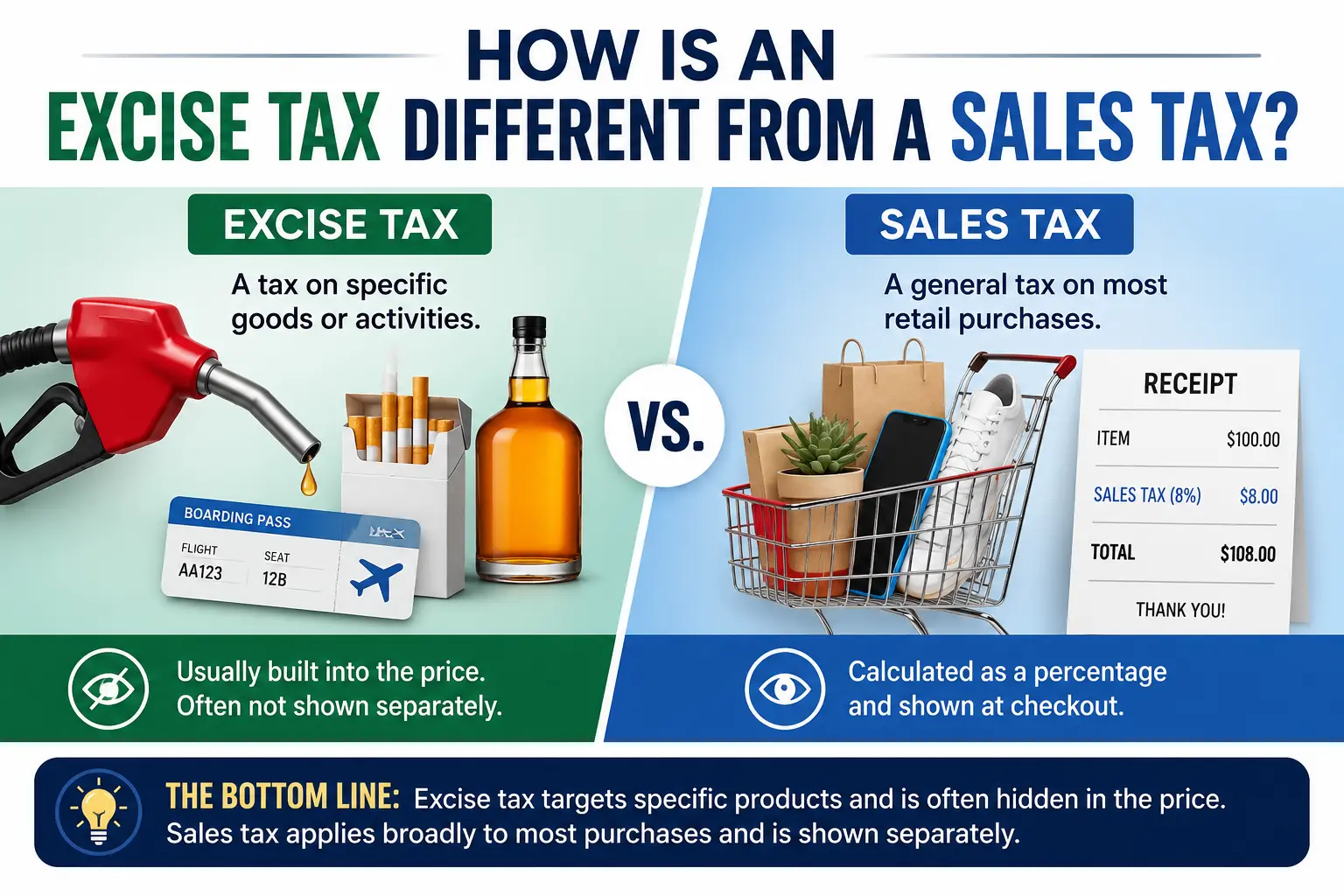
You fill up your car with gas, buy a pack of cigarettes, or book a flight, and you notice something odd. Sometimes tax shows up as a separate line item at checkout. Other times, it’s already baked into the price before you even see it.
That’s not an accident. It’s the difference between two very different types of taxes: excise tax and sales tax.
Both taxes take money out of your wallet. Both help fund government programs. But they work in different ways, apply to different things, and get collected by different rules. Understanding the difference can help you make sense of your receipts, your paycheck, and even your business’s tax obligations.
Quick Answer
Excise Tax
An excise tax is a tax on a specific product or activity, such as gasoline, alcohol, tobacco, or airline travel. It’s usually built into the purchase price, so you often pay it without seeing it listed separately on your receipt.
Sales Tax
A sales tax is a general tax charged on most retail purchases. It’s calculated as a percentage of the selling price and added at checkout, making it a separate line item on your receipt.
Excise tax applies to specific goods or activities and is usually included in the product’s advertised price.
Sales tax applies to most retail purchases and is added separately at the point of sale, so you can clearly see how much tax you’re paying.
Sales tax asks,
“What are you buying?”
Excise tax asks,
“What specific product are you buying, and does the government want to regulate, discourage, or raise revenue from it?”
This guide breaks down everything you need to know, in plain English, with real numbers and real-world examples.
What Is an Excise Tax?
An excise tax is a tax charged on a particular product, service, or activity. It’s sometimes called a “sin tax” when it applies to things like alcohol or tobacco, because one goal is to reduce consumption of goods that carry health or social costs.
The excise tax definition, in simple terms, comes down to this: it’s a tax on the manufacture, sale, or use of a specific item, rather than a general tax on all purchases.
Here’s what makes excise taxes different from most other taxes:
- They apply to a narrow category of goods or services, not everything you buy.
- They’re often charged per unit (like cents per gallon) instead of as a percentage of price.
- They’re usually paid by the manufacturer, producer, or seller first, then passed along to you in the sticker price.
- You often don’t see them listed separately on your receipt.
Common excise tax categories include:
- Gasoline and diesel fuel
- Alcohol (beer, wine, and spirits)
- Cigarettes and tobacco products
- Airline tickets
- Heavy trucks and truck tires
- Indoor tanning services
- Firearms and ammunition
- Certain vehicle purchases (through vehicle excise tax, especially at the state level)
The federal government uses excise taxes to fund specific programs. Gasoline excise tax, for example, largely supports the Highway Trust Fund, which pays for road and bridge maintenance. The IRS provides detailed guidance on federal excise taxes, including which businesses must file Form 720, the Quarterly Federal Excise Tax Return.
What Is a Sales Tax?
A sales tax is a general tax that states and local governments apply to most retail purchases. Unlike excise tax, sales tax isn’t limited to a specific product category. It applies broadly across categories like clothing, furniture, electronics, and restaurant meals.
The sales tax definition is straightforward: it’s a percentage-based tax added to the price of eligible goods and services at the point of sale.
Key features of sales tax:
- It’s calculated as a percentage of the purchase price, not a flat per-unit amount.
- Rates vary by state, county, and city.
- It’s added at checkout, so you see the exact amount on your receipt.
- The retailer collects it from you and sends it to the state.
- Some states have no statewide sales tax at all, including Alaska, Delaware, Montana, New Hampshire, and Oregon.
There’s no federal sales tax in the United States. Sales tax is a state and local matter, which is why the rate you pay depends heavily on where you’re shopping.
Practical Example: Buying a Laptop
| Item | Amount |
|---|---|
| Laptop price | $1,000 |
| Sales tax rate | 8% |
| Sales tax charged | $80 |
| Total price at checkout | $1,080 |
You can see the tax. It’s a separate line, calculated right in front of you, and it changes depending on your location.
How Excise Tax and Sales Tax Work
The biggest practical difference between these two taxes comes down to visibility and calculation method.
Sales tax works like this:
- You pick an item to buy.
- The retailer calculates a percentage of the price.
- That percentage gets added at checkout.
- You pay the item price plus the tax, shown as two separate numbers.
Excise tax works differently:
- A manufacturer or seller pays the excise tax before the product reaches the shelf or pump.
- The manufacturer builds that tax cost into the price of the product.
- You pay the final price, which already includes the excise tax.
- In many cases, you never see the excise tax broken out separately.
This is why gasoline taxes feel “hidden.” Federal and state fuel excise taxes are already folded into the price per gallon at the pump. You’re paying the tax every time you fill up, but the receipt usually shows one number, not a tax breakdown, unless your state requires disclosure.
Callout Box: Why Gasoline Tax Is Different
Federal fuel excise tax is about 18.4 cents per gallon for gasoline, and state fuel taxes vary widely on top of that. Both are included in the price you see on the sign, before you even pull up to the pump. In many states, general sales tax then applies as well, depending on state law.
Excise Tax vs Sales Tax Comparison Table
| Category | Excise Tax | Sales Tax |
|---|---|---|
| Definition | A tax on a specific product, service, or activity | A general tax on most retail purchases |
| Purpose | Fund specific programs; discourage certain consumption | Generate general revenue for state and local budgets |
| Tax Type | Often a flat per-unit charge (cents per gallon, per pack, etc.) | Percentage of the purchase price |
| Who Pays | Manufacturer or seller pays first, cost passed to consumer | Consumer pays directly at checkout |
| Who Collects | IRS (federal) or state revenue agencies (state) | State and local tax authorities, via the retailer |
| Federal | Yes, on select goods like fuel, alcohol, tobacco, air travel | No federal sales tax exists |
| State | Yes, many states add their own excise taxes | Yes, most states impose sales tax |
| Local | Rare, but some localities add excise taxes (e.g., city fuel or lodging taxes) | Common; cities and counties often add local sales tax on top of state rate |
| Visible to Consumers | Usually not shown separately | Shown as a separate line at checkout |
| Included in Price | Yes, typically baked into the sticker price | No, added on top of the listed price |
| Calculation Method | Fixed amount per unit, or sometimes a percentage | Percentage of total sale price |
| Examples | Gasoline, alcohol, cigarettes, airline tickets, indoor tanning | Clothing, electronics, furniture, restaurant meals |
| Revenue Usage | Often earmarked for specific programs (highways, health initiatives) | General fund for schools, public safety, infrastructure |
| Business Responsibility | Business must register, calculate, and remit to tax authorities | Business collects at sale and remits to the state |
| Deductibility | Sometimes deductible for businesses as an ordinary expense; rarely deductible for individuals | Deductible in limited cases if itemizing, subject to IRS rules |
Excise Tax Examples
Seeing real numbers makes the concept click. Here are common excise tax examples that most people run into.
Gasoline
- Pump price already includes federal fuel excise tax.
- State fuel excise tax is also built into the price.
- Some states then apply general sales tax on top, depending on state law.
- You typically pay one combined number at the pump, not an itemized breakdown.
Alcohol
- Federal excise tax applies to beer, wine, and spirits, with rates varying by alcohol type and volume.
- States add their own excise taxes on top of the federal rate.
- These costs are built into the shelf price at the liquor store, not added separately at checkout.
- Regular state sales tax may still apply to the final purchase, depending on the state.
Cigarettes and Tobacco
- Federal excise tax applies per pack of cigarettes.
- States add their own excise tax, and rates differ dramatically from state to state.
- Combined, these taxes make up a significant portion of the shelf price.
Airline Tickets
- Federal excise tax applies to the base fare of most domestic flights.
- Additional federal fees apply for security and airport facilities.
- These charges typically appear as separate line items on your itinerary, even though they function as excise taxes and fees rather than a general sales tax.
Heavy Trucks
- A federal excise tax applies to the first retail sale of certain heavy trucks and trailers.
- This tax is paid by the seller and factored into the truck’s price.
Indoor Tanning
- A 10% federal excise tax applies to indoor tanning services.
- Unlike many excise taxes, this one is often listed separately on the customer’s receipt, similar to a sales tax, even though it’s legally classified as an excise tax.
Vehicle Registration and Vehicle Excise Tax
- Several states charge an annual vehicle excise tax based on a vehicle’s value, in addition to standard registration fees.
- Massachusetts is a well-known example, where residents pay a motor vehicle excise tax each year based on the vehicle’s assessed value.
- This is different from the one-time sales tax charged when you first purchase a vehicle.
Sales Tax Examples
Sales tax shows up across a much broader range of everyday purchases.
Electronics
- Buy a $500 television with a 7% sales tax rate.
- You pay $35 in sales tax.
- Total charge: $535, shown clearly on your receipt.
Restaurant Meals
- Many states and cities apply sales tax to restaurant food, sometimes at a higher rate than groceries.
- A $60 dinner bill with 9% sales tax adds $5.40, bringing the total to $65.40.
Furniture
- A $2,000 sofa at 6% sales tax adds $120.
- Total cost: $2,120, itemized at checkout.
Online Shopping
- Online retailers generally must collect sales tax based on the buyer’s shipping address, following the 2018 South Dakota v. Wayfair Supreme Court decision.
- This means you’ll often see sales tax added at online checkout, just like you would in a physical store.
Clothing
- Some states exempt clothing from sales tax entirely, or exempt items under a certain price.
- Where it applies, it works the same way: a percentage added to the purchase price.
Can You Pay Both Taxes?
Yes. It’s common to pay both an excise tax and a sales tax on the same purchase.
Here’s how that plays out with gasoline in a state that applies sales tax to fuel:
- The price per gallon already includes federal and state excise taxes.
- Some states then apply their general sales tax to the total fuel price.
- You end up paying excise tax and sales tax together, even though you only see one number at the pump.
The same layering happens with alcohol. The bottle price already reflects federal and state excise taxes. Then, at checkout, the store adds its standard sales tax on top of that price. You’re paying both taxes, stacked on top of each other, in a single transaction.
Callout Box: One Purchase, Two Taxes
When you buy a six-pack of beer, you’re paying federal alcohol excise tax, state alcohol excise tax, and general sales tax, all in one purchase. Most of that is invisible, folded into the shelf price, except for the sales tax line at checkout.
Who Pays Excise Tax?
Legally, the manufacturer, producer, or retailer is usually the one who owes the excise tax to the government. But economically, the cost gets passed down the chain to you, the consumer, through a higher purchase price.
For example:
- A gasoline distributor pays fuel excise tax and raises wholesale prices to cover it.
- A liquor producer pays federal and state alcohol excise tax and prices bottles accordingly.
- An airline collects federal excise tax on ticket sales and remits it to the government.
So while businesses are legally responsible for filing and paying excise tax, consumers indirectly cover the cost every time they buy the taxed product. This is a key point that many articles gloss over: legal responsibility and economic burden aren’t the same thing.
Why Governments Collect Taxes
Taxes exist because government services and infrastructure don’t fund themselves. Governments collect taxes to ensure that public needs, from roads to schools to emergency services, have a steady source of funding.
Here’s why tax collection matters:
- Funding public infrastructure. Roads, bridges, and public transit rely heavily on tax revenue, including gas excise taxes.
- Supporting public safety. Police, fire departments, and emergency medical services are typically funded through general tax revenue.
- Paying for education. Public schools depend on a mix of state and local tax dollars.
- Providing social programs. Healthcare subsidies, unemployment support, and housing assistance rely on tax funding.
- Discouraging certain behaviors. Excise taxes on tobacco and alcohol are partly designed to reduce consumption by making these products more expensive.
Without consistent tax revenue, governments would struggle to maintain the systems that communities depend on every day.
What Are Taxes Used For?
Once collected, tax dollars get distributed across a wide range of public priorities. Broadly speaking, taxes are used for:
- Road construction and maintenance
- Public school funding
- Police and fire protection
- National defense (at the federal level)
- Healthcare programs like Medicare and Medicaid
- Public parks and recreational facilities
- Unemployment insurance
- Environmental protection programs
- Debt service on government bonds
Excise tax revenue often has a more targeted purpose than general sales tax revenue. Fuel excise taxes, for instance, are frequently earmarked specifically for transportation infrastructure through the Highway Trust Fund, rather than flowing into a general fund.
What Are State Taxes Used For?
State tax dollars, including sales tax and state-level excise tax, typically fund:
- K-12 public education
- State university systems
- State highways and transportation projects
- Medicaid programs at the state level
- State parks and natural resource management
- Public health initiatives
- State police and corrections systems
What do state income taxes pay for, specifically? In most states, income tax revenue is a major contributor to the general fund, which supports education, healthcare, and public safety. Not every state collects income tax, though. States like Texas, Florida, and Washington rely more heavily on sales tax and other revenue sources instead.
Which Taxes Do State Governments Collect?
State governments typically collect several types of taxes, including:
- Sales tax on most retail purchases
- State income tax, in the states that impose one
- State excise taxes on items like fuel, alcohol, tobacco, and sometimes vehicles
- Property tax, often collected at the local level but governed by state law
- Corporate income tax on businesses operating in the state
Not every state uses the same mix. Some rely heavily on sales tax because they don’t collect income tax, while others lean more on income tax and keep sales tax rates lower.
Who Collects Taxes in the United States?
In the United States, taxes are collected by several different levels of government, each with its own responsibilities:
- The federal government, through the Internal Revenue Service (IRS), collects federal income tax, payroll tax, and federal excise taxes.
- State governments, through state departments of revenue, collect state income tax (where applicable), state sales tax, and state excise taxes.
- Local governments, including cities and counties, collect local sales tax, property tax, and sometimes local excise taxes like hotel occupancy taxes.
This layered system means a single purchase, like a bottle of wine, can involve tax collection at the federal, state, and sometimes local level, all at once.
Is Excise Tax Deductible?
This is one of the most commonly searched questions on this topic, and the honest answer is: it depends.
For individuals:
- Most excise taxes baked into everyday purchases, like gasoline or alcohol, are not separately deductible on your personal federal tax return.
- Certain vehicle-related excise taxes may qualify as part of the personal property tax deduction if they meet IRS criteria, such as being based on the vehicle’s value and assessed annually.
- Is vehicle excise tax deductible? In some cases, yes. If your state’s vehicle excise tax is calculated based on the value of the car and charged annually, it may qualify as a deductible personal property tax if you itemize deductions.
- Is Massachusetts excise tax deductible? Massachusetts residents may be able to deduct their annual motor vehicle excise tax as a personal property tax on their federal return, if they itemize and the tax meets IRS requirements.
- Is car excise tax deductible or is auto excise tax deductible? The same general rule applies: it depends on how the tax is calculated and whether you itemize deductions instead of taking the standard deduction.
For businesses:
- Many federal excise taxes paid by a business, such as those on fuel used for business purposes or heavy trucks used in operations, can typically be deducted as an ordinary and necessary business expense.
- Some fuel excise taxes may also be eligible for a federal fuel tax credit if the fuel was used for specific non-taxable purposes, such as off-highway business use.
Important reminder: Tax rules change, and deductibility depends on your specific situation, including whether you itemize deductions and how a particular excise tax is structured. Always check current IRS guidance or speak with a qualified tax professional before claiming any excise tax deduction. This article is for general education and isn’t personalized tax or legal advice.
Federal Excise Tax vs State Excise Tax
Both the federal government and state governments impose excise taxes, but they operate independently and often apply to the same product at the same time.
| Feature | Federal Excise Tax | State Excise Tax |
|---|---|---|
| Governing Authority | U.S. Congress and the IRS | Individual state legislatures and revenue departments |
| Applies To | Nationally standardized list (fuel, alcohol, tobacco, air travel, etc.) | Varies by state; some states tax additional items |
| Rate Consistency | Same rate nationwide for a given product | Rates vary significantly from state to state |
| Filing | Reported via IRS Form 720 in most cases | Reported to the state’s department of revenue |
| Revenue Use | Often earmarked for federal programs like the Highway Trust Fund | Often earmarked for state infrastructure, health, or education programs |
| Example | 18.4 cents per gallon federal gas tax | State gas tax rates that range widely across the country |
This dual-layer system is why gasoline prices differ so much from state to state. You’re not just seeing different market prices. You’re seeing different combinations of federal and state excise taxes baked into that per-gallon number.
A Brief History of Excise and Sales Taxes in the US
Excise taxes are actually older than sales taxes in American history. The federal government has used excise taxes since the country’s earliest days, including a tax on whiskey in 1791 that was so unpopular it sparked the Whiskey Rebellion. Congress leaned on excise taxes repeatedly in the 1800s and early 1900s, especially during wartime, when the government needed fast, targeted revenue.
Sales tax came much later. States didn’t widely adopt general sales taxes until the Great Depression in the 1930s, when falling property values and incomes forced states to look for new, steadier sources of revenue. Mississippi was the first state to adopt a general sales tax, in 1930, and other states gradually followed.
That history explains a lot about how these taxes function today. Excise tax has always been about targeting specific goods, often for a specific funding purpose or to discourage certain behavior. Sales tax, by contrast, developed as a broad, flexible way for states to fund general government operations as their needs grew.
Business Implications of Excise Tax and Sales Tax
If you run a business, these two taxes create very different compliance obligations.
Sales tax responsibilities for businesses:
- Register with your state’s department of revenue to collect sales tax.
- Calculate the correct rate based on your customer’s location, which can vary by city and county.
- Collect the tax at the point of sale and keep accurate records.
- File and remit collected sales tax to the state on a regular schedule, often monthly or quarterly.
- Track exemptions carefully, since some products or buyers (like nonprofits or resellers) may be exempt.
Excise tax responsibilities for businesses:
- Determine whether your product or activity is subject to federal, state, or local excise tax.
- Register with the IRS and file Form 720 if you owe federal excise tax.
- Calculate excise tax per unit, since many excise taxes are charged per gallon, per pack, or per item rather than as a percentage.
- Build the excise tax cost into your pricing, since it’s usually paid before the sale to the end consumer.
- Watch for available credits or exemptions, such as fuel tax credits for off-highway business use.
Because excise tax compliance is often more specialized than sales tax compliance, many small businesses that only sell general merchandise never have to deal with it directly. But businesses in fuel, alcohol, tobacco, transportation, or certain equipment industries need to understand both systems well.
💰 Consumer Implications: What This Means for Your Wallet
Understanding how these two taxes work can help you budget more accurately, compare prices between states, and avoid surprises at checkout.
🛒 Sales Tax
Sales tax is generally predictable and transparent. Since it’s calculated as a percentage of your purchase and added at checkout, you can estimate the amount before you buy. If you move to a different city or state, checking the local sales tax rate can help you plan your spending more accurately.
⛽ Excise Tax
Excise tax is usually hidden in the advertised price. Whether you’re buying gasoline, cigarettes, or alcohol, you’re already paying the tax—even if it doesn’t appear as a separate line on your receipt. Changes in federal or state excise tax rates can increase prices without making the reason obvious to consumers.
📍 Why Prices Vary Between States
If you’ve noticed that gasoline, cigarettes, or alcoholic beverages cost much more in one state than another, excise taxes are often a major reason. States set their own excise tax rates on many products, so crossing a state border can result in noticeably different prices—even when the products themselves are identical.
Budgeting Tip: When comparing prices, remember that sales tax usually appears at checkout, while excise tax is typically built into the shelf or pump price. Knowing which tax you’re paying can help explain why identical products cost different amounts in different locations.
Common Myths About Excise Tax
Many people confuse excise taxes with sales taxes or misunderstand how they work. Here are some of the most common myths—and the facts behind them.
Myth: Excise tax and sales tax are the same thing.
Sales tax is a broad, percentage-based tax added to most retail purchases at checkout. Excise tax applies only to specific products or activities, is often calculated as a fixed amount per unit, and is usually included in the advertised price rather than shown separately.
Myth: If you don’t see a tax on your receipt, you’re not paying one.
Many excise taxes—such as those on gasoline, alcohol, and tobacco—are built into the purchase price before you buy the product. Even if your receipt doesn’t list them separately, you’ve already paid them.
Myth: Only “bad” products are subject to excise tax.
Although tobacco and alcohol are well-known examples, excise taxes also apply to airline tickets, indoor tanning services, heavy trucks, and other goods or activities. Some excise taxes discourage certain behavior, while others help fund specific public programs or infrastructure.
Myth: Businesses absorb the full cost of excise tax.
Businesses are often responsible for reporting and remitting excise taxes, but they typically recover those costs by including them in the prices consumers ultimately pay.
Myth: All excise taxes are deductible for individuals.
Not all excise taxes qualify for a tax deduction. Whether an excise tax is deductible depends on the type of tax, how it’s assessed, and your individual tax situation. Many excise taxes built into everyday purchases are not deductible for most taxpayers.
💡 Quick Tip
When you’re unsure whether a charge is an excise tax or a sales tax, ask yourself two questions: Is it applied only to a specific product or activity? If yes, it’s likely an excise tax. Is it added as a percentage to most retail purchases at checkout? If so, it’s likely a sales tax.
Conclusion
Excise tax and sales tax might both show up in your monthly budget, but they work in very different ways. Sales tax is the visible, percentage-based charge added to most of your everyday purchases. Excise tax is the quieter, often-hidden tax built into the price of specific products like gasoline, alcohol, tobacco, and airline tickets.
Knowing the difference helps you understand your receipts, your gas station price sign, and even your business’s tax responsibilities. It also helps explain why prices for the same product can vary so much from state to state, since both federal and state governments layer their own excise taxes on top of each other.
If you’re trying to figure out exact costs for a purchase, whether you’re calculating a sales-tax-inclusive price or backing sales tax out of a total, a reverse sales tax calculator can make the math simple. For state-specific rates, a state sales tax guide can help you confirm exactly what you’ll pay based on where you live.
Tax rules can change over time, and specific deductions depend on your personal or business situation. When in doubt, check current guidance from the IRS or consult a qualified tax professional before making decisions based on excise tax or sales tax rules.v
Frequently Asked Questions
Is excise tax the same as sales tax? No. Excise tax applies to specific products or services and is usually included in the price. Sales tax applies broadly to most purchases and is added separately at checkout.
Why is gasoline taxed differently? Gasoline carries both federal and state excise taxes that are built directly into the per-gallon price, rather than added as a separate line item like sales tax. This makes fuel tax largely invisible to the average driver.
Can one purchase have both taxes? Yes. Many purchases, like alcohol or gasoline in certain states, include excise tax built into the price and general sales tax added on top at checkout.
Who pays excise taxes? Manufacturers, producers, or sellers are legally responsible for paying excise tax to the government, but they typically pass that cost to consumers through higher prices.
Is excise tax included in the price? Usually, yes. Most excise taxes are built into the price of the product before you buy it, unlike sales tax, which is added afterward.
Why do governments collect taxes? Governments collect taxes to fund public services like roads, schools, public safety, and healthcare programs that benefit the community as a whole.
What are taxes used for? Tax revenue funds infrastructure, education, public safety, healthcare programs, and a wide range of other government services at the federal, state, and local level.
Is excise tax deductible? Sometimes. Business excise taxes are often deductible as a business expense. For individuals, deductibility depends on the specific tax and whether you itemize deductions.
Can excise tax be claimed? In certain situations, yes, particularly for businesses claiming excise tax as an operating expense, or for specific fuel tax credits. Individuals should check IRS rules or consult a tax professional before claiming any excise tax.
Is vehicle excise tax deductible? It can be, if the tax is based on the vehicle’s value and charged annually, and if you itemize deductions on your federal return. Confirm your state’s specific tax structure before claiming it.
What’s the difference between excise tax and a tariff? A tariff is a tax on imported goods, charged when products cross international borders. Excise tax applies to specific goods regardless of whether they’re domestic or imported, once they’re sold or used within the country.
Do all states charge the same excise tax on gasoline? No. While the federal fuel excise tax is consistent nationwide, state fuel excise taxes vary significantly, which is a major reason gas prices differ from state to state.
Is sales tax charged on services? It depends on the state. Some states tax certain services, like repairs or short-term rentals, while others only tax the sale of physical goods.
Do online purchases include sales tax? Generally, yes. Most online retailers are required to collect sales tax based on the buyer’s shipping address, following changes in tax law after the South Dakota v. Wayfair Supreme Court ruling.
Can a business be exempt from paying excise tax? In some cases, yes. Certain uses, like fuel used for off-highway business purposes, may qualify for excise tax exemptions or credits. Eligibility depends on IRS rules and documentation.
This article is for general educational purposes only and does not constitute tax or legal advice.
