

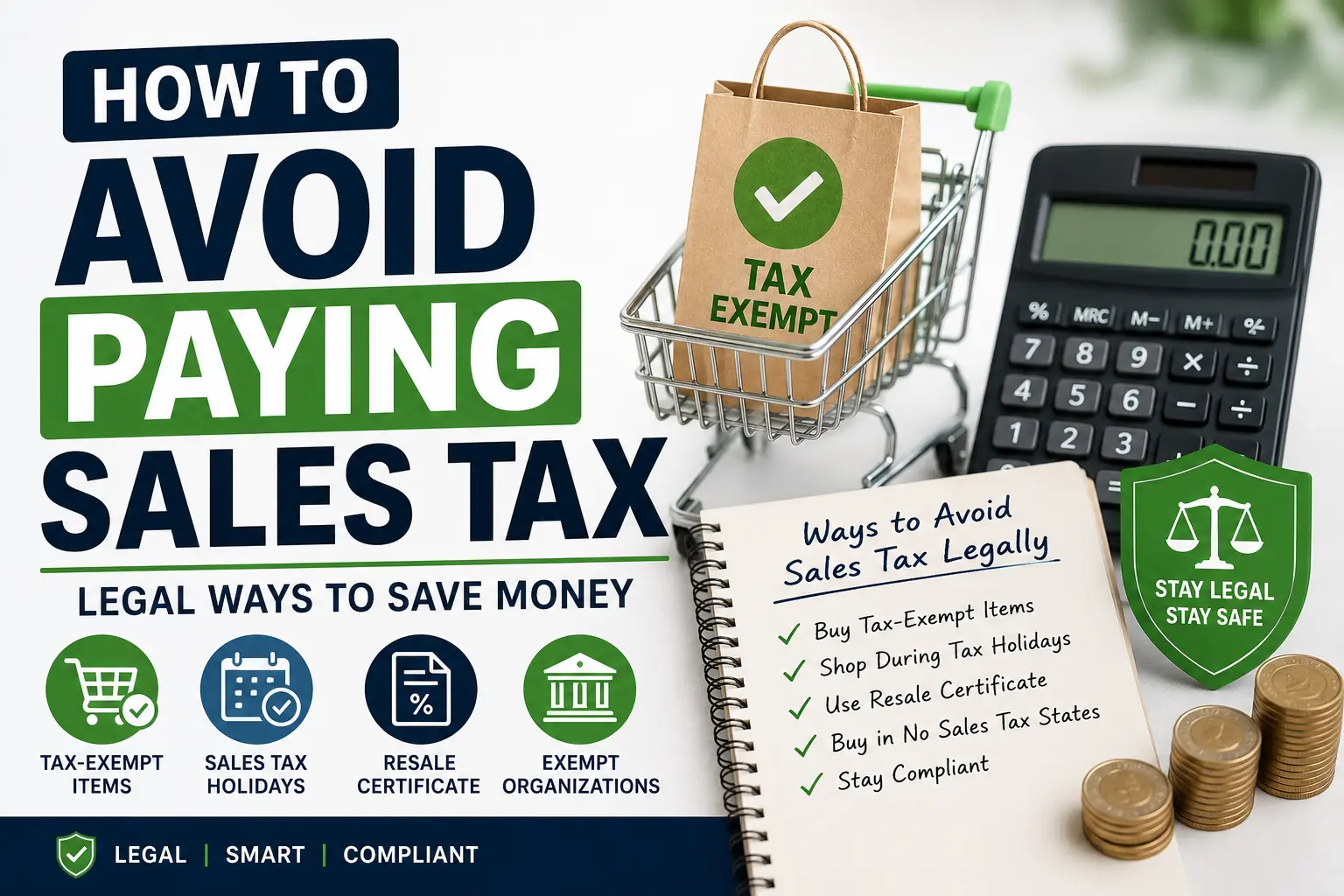
Let’s clear up one of the biggest misconceptions about sales tax.
There is no legal trick that lets anyone simply skip paying sales tax whenever they want. Sales tax is governed by state and local laws, and businesses are generally required to collect it on taxable sales.
That doesn’t mean you’ll always have to pay it.
There are several legal situations where sales tax doesn’t apply. Depending on where you live, what you’re buying, or why you’re buying it, you may qualify for a sales tax exemption. For example, some states exempt groceries or prescription medicines, while qualified nonprofit organizations and businesses purchasing goods for resale may also qualify for tax-exempt purchases.
Understanding these rules can help you save money while staying compliant with the law.
In this guide, you’ll learn:
- Legal ways to avoid paying sales tax
- Who qualifies for sales tax exemptions
- How resale certificates work
- Which states have no statewide sales tax
- The difference between tax avoidance and tax evasion
- Common mistakes that can lead to penalties
Let’s start with the most important question.
Can You Legally Avoid Paying Sales Tax?
Yes—but only in situations allowed by law.
Sales tax laws differ by state, and many states also allow counties, cities, and special districts to impose their own local sales taxes. Whether you owe sales tax depends on factors such as:
- The type of product or service
- Where the purchase takes place
- Whether the buyer qualifies for an exemption
- Whether the purchase is for personal use or resale
For example, buying a loaf of bread may be exempt from sales tax in one state but taxable in another. Likewise, a business purchasing inventory for resale often does not pay sales tax at the time of purchase because the tax is collected from the final customer instead.
The key point is simple:
Legal tax avoidance means following the tax laws exactly as written. It does not involve hiding purchases, providing false information, or refusing to pay taxes that are legally due.
Buy Tax-Exempt Products
One of the easiest legal ways to avoid paying sales tax is by purchasing items that your state classifies as tax-exempt.
Not every product is subject to sales tax. Many states exempt certain essential goods to reduce the tax burden on consumers. However, these exemptions vary by jurisdiction, so it’s important to check your state’s rules.
Common examples include:
Groceries
Many states exempt most grocery items from sales tax or tax them at a reduced rate. Fresh fruits, vegetables, milk, bread, and other staple foods often qualify.
Prepared meals, restaurant food, and soft drinks may still be taxable, depending on the state.
Prescription Medications
Prescription drugs are exempt from sales tax in many states. This exemption helps reduce healthcare costs for consumers.
Over-the-counter medicines, however, may be treated differently depending on local tax laws.
Certain Medical Devices
Some medical equipment prescribed by a healthcare provider may qualify for a sales tax exemption.
Examples may include:
- Wheelchairs
- Prosthetic devices
- Hearing aids
- Durable medical equipment
Eligibility requirements differ by state.
Clothing
A few states exempt clothing entirely, while others apply exemptions only during sales tax holidays or up to certain price limits.
Because these rules vary significantly, shoppers should verify the applicable regulations before making large purchases.
Shop During Sales Tax Holidays
Another legal way to avoid paying sales tax is by shopping during a sales tax holiday.
A sales tax holiday is a limited period when participating states temporarily waive sales tax on specific items.
These events are created by state governments and often occur before the school year begins or during disaster preparedness seasons.
Eligible purchases commonly include:
- School supplies
- Clothing
- Footwear
- Computers
- Educational materials
- Hurricane preparedness equipment in some states
Each state sets its own rules, including:
- Eligible product categories
- Maximum purchase price
- Holiday dates
- Participating retailers
For example, a state may exempt clothing priced under a certain dollar amount while continuing to tax more expensive items.
Shopping during these events can help families save money on back-to-school purchases and other qualifying products.
Before making a purchase, check your state’s official tax agency website to confirm the dates and eligible items.
Use a Resale Certificate for Business Purchases
If you operate a retail business, you may qualify to purchase inventory without paying sales tax.
This is possible through a resale certificate, sometimes called a reseller permit or resale exemption certificate.
Here’s how it works.
When a retailer buys products that will later be sold to customers, the retailer generally does not pay sales tax to the supplier. Instead, the retailer collects sales tax from the final customer at the point of sale and remits it to the appropriate tax authority.
This prevents the same product from being taxed multiple times as it moves through the supply chain.
Example
Imagine you own a sporting goods store.
You purchase 200 baseball gloves from a wholesaler.
Because the gloves are intended for resale, you provide a valid resale certificate to the supplier.
The wholesaler does not charge sales tax on that transaction.
Later, when customers purchase the gloves from your store, you collect sales tax from them if required under your state’s laws.
Important Responsibilities
A resale certificate should only be used for items that will actually be resold.
Using a resale certificate to purchase personal items without paying sales tax is considered tax fraud and can result in penalties, interest, and additional taxes.
If you’re unsure whether your purchase qualifies, consult your state’s tax authority or a qualified tax professional.
Tax-Exempt Organizations
Some organizations qualify for sales tax exemptions because of their legal status.
Examples may include:
- Certain charitable organizations
- Religious organizations
- Educational institutions
- Government agencies
However, not every nonprofit organization automatically qualifies for a sales tax exemption.
Eligibility depends on state law, and many organizations must apply for exempt status through the state’s tax agency before making tax-free purchases.
Even when an organization receives tax-exempt status, the exemption often applies only to purchases made for official organizational purposes.
For example, office supplies purchased for a registered nonprofit may qualify, while personal purchases by employees generally do not.
Organizations should retain documentation supporting their exempt status and present it when required by retailers.
Purchase in States With No Statewide Sales Tax
One of the most commonly discussed ways to reduce sales tax is shopping in a state that does not impose a statewide sales tax.
As of 2026, five states do not have a statewide sales tax:
- Alaska (many local jurisdictions still impose local sales taxes)
- Delaware
- Montana
- New Hampshire
- Oregon
This doesn’t always mean every purchase will be tax-free.
For example, Alaska allows many cities and boroughs to levy local sales taxes. As a result, shoppers may still owe tax depending on where they make a purchase.
It’s also important to understand that purchasing goods in a state without sales tax does not necessarily eliminate tax obligations in your home state. Many states require residents to pay use tax on taxable items purchased elsewhere if sales tax was not collected at the time of sale.
Understanding these rules can help you avoid unexpected tax liabilities while ensuring you remain compliant with applicable laws.
Online Shopping and Sales Tax
Years ago, many shoppers believed buying online meant they could avoid sales tax. That is no longer true in most cases.
Today, online retailers generally collect sales tax when required by state law. This change came after the 2018 U.S. Supreme Court decision in South Dakota v. Wayfair, Inc., which allowed states to require many remote sellers to collect and remit sales tax even if they don’t have a physical store in that state.
As a result, whether you shop online or in person, you will often pay the same sales tax.
Why Online Stores Collect Sales Tax
Many states have adopted economic nexus laws.
An economic nexus means a business must collect sales tax once it reaches certain sales or transaction thresholds within a state.
For example, an online retailer that sells products to customers across the country may need to register and collect sales tax in multiple states after meeting those thresholds.
This helps create a more level playing field between local stores and online businesses.
Marketplace Facilitator Laws
Many online marketplaces now collect and remit sales tax on behalf of third-party sellers.
These marketplaces include large e-commerce platforms where independent businesses sell products.
In many states, the marketplace—not the individual seller—is responsible for calculating, collecting, and remitting the tax.
Always review your order summary before checkout to see whether sales tax has been applied.
What About Use Tax?
If an online retailer does not collect sales tax, you may still owe use tax in your home state.
Use tax generally applies when:
- A taxable purchase was made without paying sales tax.
- The item is used, stored, or consumed in your state.
Many states require residents and businesses to report and pay use tax on their state income tax returns or through a separate filing process.
Ignoring use tax obligations can result in interest or penalties if discovered during an audit.
Tax Avoidance vs. Tax Evasion
Many people confuse these two terms, but they have very different meanings.
Understanding the difference can help you stay on the right side of the law.
Tax Avoidance
Tax avoidance means reducing your tax liability legally by following the tax rules established by federal, state, and local governments.
Examples include:
- Purchasing tax-exempt items.
- Shopping during a sales tax holiday.
- Using a valid resale certificate for inventory purchases.
- Claiming a lawful sales tax exemption.
These actions comply with tax laws and are completely legal.
Tax Evasion
Tax evasion involves intentionally avoiding taxes that you legally owe.
Examples include:
- Using someone else’s exemption certificate.
- Falsifying resale documents.
- Claiming personal purchases as business inventory.
- Hiding taxable sales.
- Failing to remit sales tax collected from customers.
Tax evasion is illegal and can lead to:
- Financial penalties.
- Interest charges.
- Audits.
- Civil lawsuits.
- Criminal prosecution in serious cases.
The safest approach is simple: if you’re unsure whether an exemption applies, verify the rules with your state’s tax authority or seek advice from a qualified tax professional.
Common Mistakes to Avoid
Even well-intentioned shoppers and business owners can make mistakes when dealing with sales tax.
Here are some of the most common ones.
Assuming Every State Has the Same Rules
Sales tax laws differ across the United States.
A product that is tax-exempt in one state may be fully taxable in another.
Always verify the rules for the state where the purchase occurs.
Misusing a Resale Certificate
A resale certificate is only for products that will be resold.
Buying office furniture, laptops, or personal items with a resale certificate when they are not intended for resale may violate state tax laws.
Maintain accurate records to support every tax-exempt purchase.
Forgetting About Local Sales Taxes
Many people focus only on the statewide sales tax rate.
However, counties, cities, and special districts often impose additional local taxes.
The combined tax rate may be higher than the statewide rate alone.
Assuming Online Purchases Are Always Tax-Free
Most large online retailers now collect sales tax where required.
If they do not, you may still owe use tax in your home state.
Ignoring Tax Documentation
Businesses should keep:
- Sales receipts.
- Exemption certificates.
- Resale certificates.
- Purchase invoices.
- Tax records.
Good recordkeeping helps support tax filings and simplifies audits.
Tips to Stay Compliant While Saving Money
You don’t need questionable schemes to reduce your tax bill.
Instead, follow these practical tips:
- Learn your state’s sales tax rules.
- Shop during official sales tax holidays when available.
- Verify whether essential items qualify for exemptions.
- Use resale certificates only for legitimate business inventory.
- Keep accurate purchase records.
- Review receipts to ensure the correct tax rate was applied.
- Consult a tax professional if you’re unsure about an exemption.
These habits can help you save money while remaining fully compliant with applicable laws.
Final Thoughts
Searching for how to avoid paying sales tax often leads people to believe there’s a hidden loophole that eliminates sales tax altogether. In reality, the law provides only a limited number of legitimate exemptions.
The most effective way to reduce sales tax is to understand the rules that apply to your purchases. Tax-exempt products, sales tax holidays, resale certificates, and qualified nonprofit exemptions all exist for specific reasons, and each comes with its own requirements.
Whether you’re a shopper looking to save money or a business owner managing inventory, staying informed helps you make better financial decisions while avoiding costly mistakes.
When in doubt, rely on official guidance from your state’s tax agency or consult a qualified tax professional. A few minutes of research today can save you time, money, and unnecessary complications later.
Frequently Asked Questions
Can I legally avoid paying sales tax?
Yes. Certain purchases qualify for sales tax exemptions under state law. Examples include eligible tax-exempt products, purchases made with a valid resale certificate, and items bought during a state’s sales tax holiday.
Which states do not have a statewide sales tax?
As of 2026, these five states do not impose a statewide sales tax:
- Alaska (local sales taxes may still apply)
- Delaware
- Montana
- New Hampshire
- Oregon
Residents and visitors should still check local tax rules because additional taxes may exist in some jurisdictions.
Can nonprofits avoid paying sales tax?
Some nonprofit organizations qualify for state sales tax exemptions.
However, eligibility varies by state, and organizations often need to apply for exempt status before making tax-free purchases.
Do online purchases still have sales tax?
In many cases, yes.
Most online retailers collect sales tax where required under state laws and marketplace facilitator regulations.
What is a resale certificate?
A resale certificate allows eligible businesses to purchase inventory without paying sales tax because the tax will generally be collected from the final customer when the product is sold.
What happens if I misuse a tax exemption?
Improper use of a tax exemption or resale certificate may result in additional taxes, interest, penalties, and possible legal action, depending on state law.
