

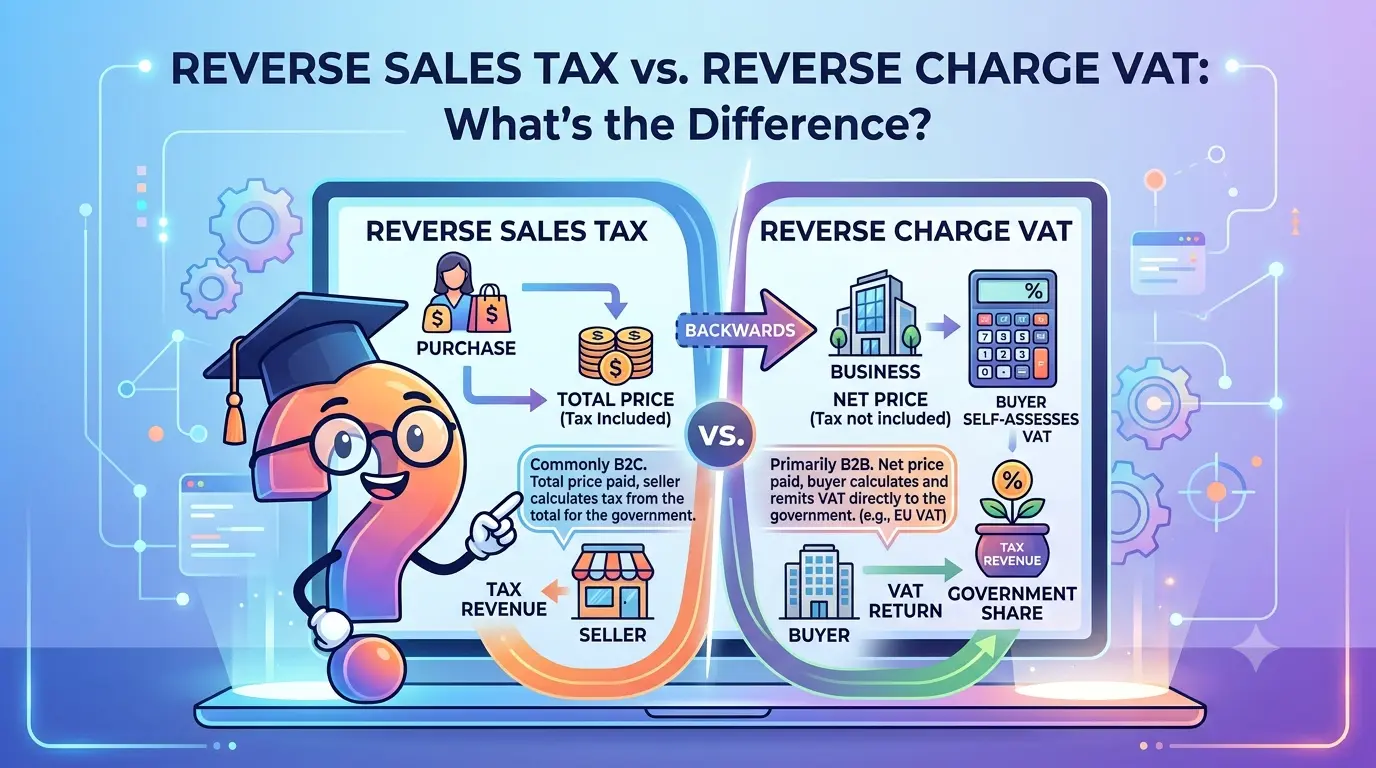
The names look almost identical, but “reverse sales tax” and “reverse charge VAT” describe two completely different things. One is a simple math formula. The other is a legal mechanism used in certain VAT systems to decide who is responsible for reporting tax. This page explains the difference clearly, so you don’t confuse the two.
Quick Answer
Reverse sales tax is a calculation that finds the price before tax from a tax-included total. Reverse charge VAT is a rule used in some VAT systems where the responsibility for reporting and accounting for VAT shifts from the seller to the buyer, rather than the seller charging VAT directly. They share the word “reverse,” but they solve completely different problems — one is arithmetic, the other is a compliance and reporting mechanism.
What Is Reverse Sales Tax?
Reverse sales tax is a formula used to work backward from a total price to find the amount before tax:
Before Tax Price = Final Price ÷ (1 + Tax Rate)
Anyone can use this calculation — a shopper checking a receipt, a business reconciling revenue, or a student learning the math. It doesn’t involve any legal reporting obligation. It’s simply a way to break a total into its price and tax components.
What Is Reverse Charge VAT?
Reverse charge VAT is a mechanism used within certain VAT systems, most notably in the UK and the European Union. Under normal VAT rules, the seller charges VAT to the buyer and reports it to the tax authority. Under a reverse charge, that responsibility shifts: the buyer, rather than the seller, is responsible for accounting for the VAT on the transaction directly to the tax authority.
Reverse charge VAT is commonly applied to certain business-to-business (B2B) transactions, including some cross-border sales within the EU, and to specific domestic industries in some countries. The exact rules, thresholds, and covered transaction types vary by country and change over time, so this page describes the general concept only, not the specific rules of any one jurisdiction.
Key Differences
| Reverse Sales Tax | Reverse Charge VAT | |
|---|---|---|
| What it is | A math calculation | A tax reporting and compliance mechanism |
| Who uses it | Anyone — shoppers, businesses, students | Registered businesses in applicable VAT transactions |
| Purpose | Find the price before tax from a total | Shift responsibility for reporting VAT from seller to buyer |
| Involves a formula? | Yes, a simple division formula | No standard formula — it’s a procedural/legal rule |
| Common context | Any receipt, invoice, or purchase with sales tax | Specific B2B and cross-border VAT transactions |
| Where it applies | Primarily U.S. sales tax contexts | UK, EU, and other VAT systems with reverse charge rules |
Why the Names Overlap
Both terms use the word “reverse,” but they mean different things by it:
- In reverse sales tax, “reverse” refers to reversing the math — starting from a total and working backward to the pre-tax price.
- In reverse charge VAT, “reverse” refers to reversing who is responsible for reporting the tax — normally the seller, but shifted to the buyer under this mechanism.
The similarity is a coincidence of naming, not a sign that the two concepts are related.
An Example That Shows the Difference
Reverse sales tax (a calculation): A retail total of $107.50 with 7.5% tax means the pre-tax price was $100.00 and the tax was $7.50. Anyone can do this math on any receipt.
Reverse charge VAT (a compliance rule): A UK business purchases services from a supplier in another EU country. Instead of the supplier charging UK VAT, the UK business itself accounts for the VAT on its own VAT return, under the reverse charge rule. No formula from this site applies here — it’s a matter of who reports the tax, not how the tax is calculated.
Frequently Asked Questions
Does Tiblor’s calculator handle reverse charge VAT? No. Our calculator performs the reverse sales tax formula (Final Price ÷ (1 + Rate)) to find a pre-tax price. Reverse charge VAT is a reporting obligation, not a calculation our tool is designed to determine.
Is reverse charge VAT the same as reverse VAT calculation? No. “Reverse VAT calculation” typically refers to the math of finding a pre-VAT price from a total, similar to reverse sales tax. “Reverse charge VAT” refers to who is responsible for reporting VAT on a transaction. They are unrelated concepts that happen to share similar wording.
Who needs to know about reverse charge VAT? Businesses involved in certain B2B or cross-border VAT transactions may need to understand reverse charge rules. This typically requires guidance from a licensed accountant or tax advisor familiar with the applicable country’s VAT rules.
Does reverse charge VAT apply in the United States? The U.S. does not have a VAT system, so reverse charge VAT, as a VAT-specific mechanism, does not apply to U.S. sales tax.
Where can I learn the specific reverse charge VAT rules for my business? Because rules vary by country, industry, and transaction type, and change over time, consult your country’s tax authority or a licensed tax professional for guidance specific to your situation.
Disclaimer
This page is for educational purposes only and does not constitute tax, legal, or financial advice. Reverse charge VAT rules are specific to certain VAT jurisdictions, vary by country and transaction type, and change over time. Tiblor does not provide guidance on whether reverse charge VAT applies to a specific transaction. For accurate, current guidance, consult a licensed tax professional or your relevant tax authority.
