

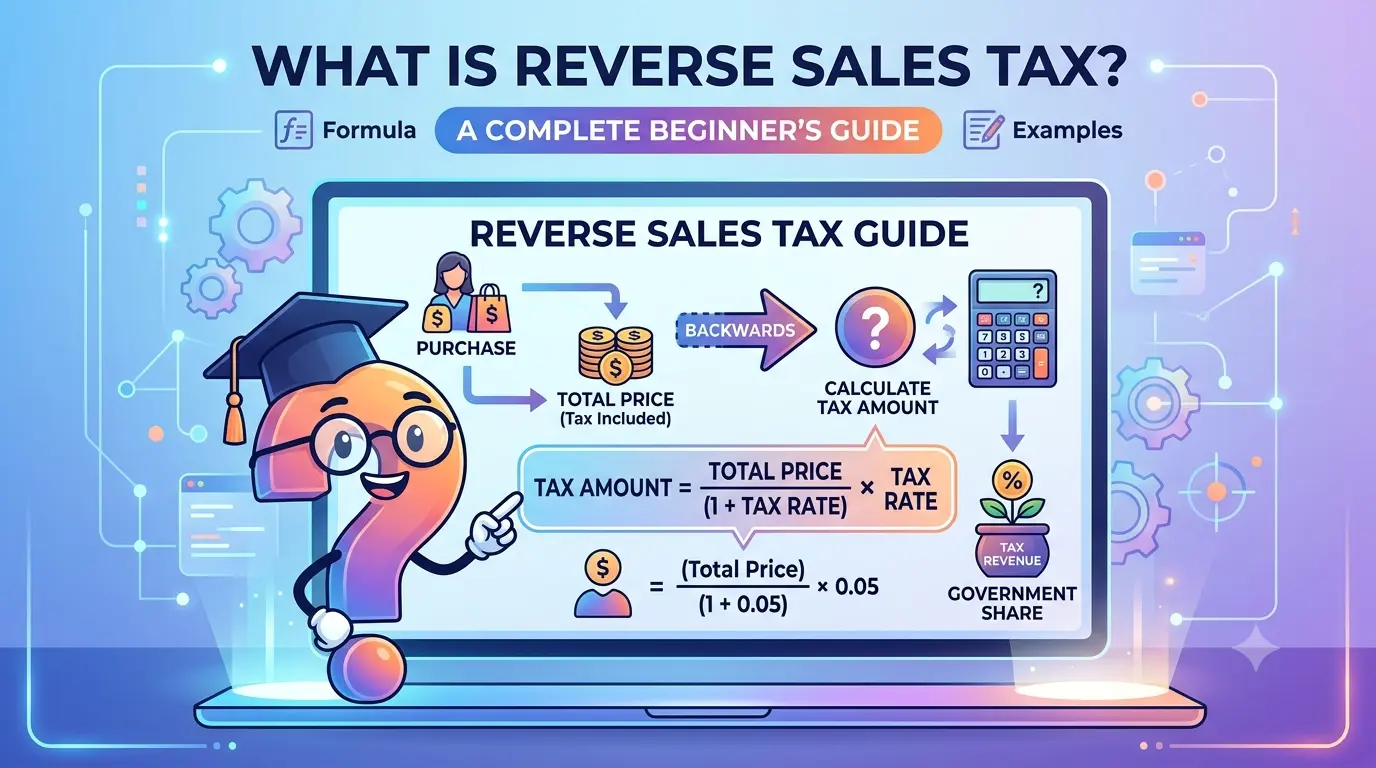
Reverse sales tax is a calculation that finds the price of an item before tax was added, using only the final price and the tax rate. Instead of adding tax to a price, you divide the total by 1 plus the tax rate. For example, a $107.50 total with 7.5% tax means the original price was $100.00, and the tax was $7.50. Try it yourself with our reverse sales tax calculator.
Table of Contents
What Is Reverse Sales Tax?
Reverse sales tax is the process of figuring out the original, pre-tax price of something when you only know the final price and the tax rate. It’s the opposite of a normal sales tax calculation, which starts with a price and adds tax to it.
In plain English: if you know how much you paid in total, reverse sales tax tells you how much of that was the actual price of the item, and how much was tax.
This matters because most receipts, invoices, and totals show you a single combined number. Reverse sales tax lets you break that number apart.
Three terms come up often in this topic, so let’s define them clearly:
- Tax-inclusive price (final price): The total amount actually paid, including tax.
- Original price (pre-tax price): The price of the item before any tax was added.
- Tax amount: The portion of the final price that was tax.
Here’s the relationship, visualized:
Original Price
      ↓
 Sales Tax Added
      ↓
  Final Price
      ↓
Reverse Sales Tax
      ↓
Original Price Found
Reverse sales tax simply runs that first process backward.
Why Is It Called “Reverse” Sales Tax?
The name trips a lot of people up, so it’s worth explaining directly.
A normal, “forward” sales tax calculation starts with a known price and adds tax to it:
Price → + Tax → Final Price
Reverse sales tax starts with the opposite piece of information. You already know the final price, and you’re solving for the original price:
Final Price → − Tax → Original Price
It’s called “reverse” because you’re working in the opposite direction of the usual calculation — starting where a normal calculation ends, and ending where it starts.
Common Confusion: Reverse sales tax is not a refund, a discount, or a special tax rule. It’s simply a calculation that runs in reverse. If you’re looking for information on refunds specifically, see our Reverse Sales Tax vs. Tax Refund page.
When Do You Need to Calculate Reverse Sales Tax?
Reverse sales tax comes up more often than most people realize. Here are common situations:
| Situation | Why Reverse Sales Tax Helps |
|---|---|
| Store receipt | Find the pre-tax price of an item you bought |
| Restaurant bill | Verify the tax charged matches the local rate |
| Business invoice | Record the taxable amount separately from tax |
| Expense reimbursement | Separate the tax portion from the total for accounting |
| Vehicle purchase | Estimate how much of the out-the-door price was tax |
| Returned item | Determine the correct refund amount, tax included |
| Revenue reconciliation | Break gross, tax-included sales into net sales and tax collected |
Who Uses Reverse Sales Tax?
Reverse sales tax isn’t just for accountants. Here’s who relies on it, and why:
- Consumers — checking whether a receipt charged the correct tax
- Small business owners — reconciling sales tax collected against revenue
- Accountants — preparing accurate financial records for clients
- Bookkeepers — separating tax from net sales in day-to-day recordkeeping
- Retailers — pricing items correctly and auditing point-of-sale reports
- Online sellers — managing tax across multiple state or country rates
- Contractors — calculating the taxable portion of invoiced project costs
- Finance teams — reporting accurate net revenue figures
How Does Reverse Sales Tax Work?
Before looking at the formula, it helps to understand the concept in plain terms.
Here’s what happens during a normal purchase:
Item Costs a Certain Amount
        ↓
   Sales Tax Added
        ↓
  Customer Pays Total
Now here’s what happens when you need to reverse it:
You Know the Total Paid
        ↓
You Need the Original Price
        ↓
   Reverse Calculation
The final price isn’t the original price plus a random number — it’s the original price multiplied by (1 + the tax rate). Because of that relationship, you can’t just subtract the tax percentage from the total to get back to the original price. You have to divide. The next section shows exactly how.
Reverse Sales Tax Formula
Here’s the formula:
Original Price = Total Price ÷ (1 + Tax Rate)
Breaking down each variable:
- Total Price — the final amount paid, including tax
- Tax Rate — the sales tax percentage, written as a decimal (7.5% becomes 0.075)
- Original Price — the result: the price before tax was added
Once you have the original price, finding the tax amount is simple:
Tax Amount = Total Price − Original Price
Why the Formula Works
A normal sales tax calculation looks like this:
Total Price = Original Price × (1 + Tax Rate)
To reverse it, you isolate “Original Price” by dividing both sides of the equation by (1 + Tax Rate):
Original Price = Total Price ÷ (1 + Tax Rate)
That’s the entire derivation. It’s basic algebra — solving for a different variable than usual, using the same relationship.
Step-by-Step Examples
Example 1: Retail Receipt
- Receipt Total: $107.50
- Tax Rate: 7.5%
- Calculation: 107.50 ÷ 1.075 = 100.00
- Result: Original price was $100.00, tax was $7.50
Example 2: Restaurant Bill
- Bill Total: $54.00
- Tax Rate: 8%
- Calculation: 54.00 ÷ 1.08 = 50.00
- Result: Original price was $50.00, tax was $4.00
Example 3: Furniture Purchase
- Receipt Total: $875.00
- Tax Rate: 6.25%
- Calculation: 875.00 ÷ 1.0625 = 823.53
- Result: Original price was $823.53, tax was $51.47
Example 4: Electronics
- Receipt Total: $329.99
- Tax Rate: 8.875%
- Calculation: 329.99 ÷ 1.08875 = 303.09
- Result: Original price was $303.09, tax was $26.90
Example 5: Vehicle Purchase
- Out-the-Door Price: $32,400
- Tax Rate: 6.25%
- Calculation: 32,400 ÷ 1.0625 = 30,494.12
- Result: Original price was $30,494.12, tax was $1,905.88
Every example above uses the exact same formula. Only the numbers change.
Reverse Sales Tax Calculation Table
Use this table as a quick reference for common tax rates and totals.
| Tax Rate | Total | Original Price | Tax Amount |
|---|---|---|---|
| 4% | $100.00 | $96.15 | $3.85 |
| 5% | $100.00 | $95.24 | $4.76 |
| 6% | $100.00 | $94.34 | $5.66 |
| 7% | $100.00 | $93.46 | $6.54 |
| 8% | $100.00 | $92.59 | $7.41 |
| 6% | $500.00 | $471.70 | $28.30 |
| 8% | $500.00 | $462.96 | $37.04 |
| 6.5% | $1,000.00 | $938.97 | $61.03 |
| 9% | $1,000.00 | $917.43 | $82.57 |
For a custom price or rate, use the reverse sales tax calculator for an exact result.
Reverse Sales Tax vs. Sales Tax
| Sales Tax | Reverse Sales Tax | |
|---|---|---|
| Starting point | Price before tax | Final price (tax included) |
| Direction | Adds tax | Removes tax |
| Goal | Find the final price | Find the original price |
| Formula | Original Price × (1 + Tax Rate) | Total Price ÷ (1 + Tax Rate) |
Reverse Sales Tax vs. Tax Refund
These are completely different concepts, despite sometimes coming up in similar situations.
Reverse sales tax is a calculation — it tells you how much of a total was tax. A tax refund is an actual repayment of money, such as when a store refunds you for a returned item, or when a tourist reclaims VAT before leaving a country.
Reverse sales tax math is sometimes used to calculate a refund amount, but the calculation itself is not a refund.
Reverse Sales Tax vs. VAT & GST
Outside the United States, most countries use VAT (Value Added Tax) or GST (Goods and Services Tax) instead of sales tax. The reverse calculation formula is identical — divide the total by 1 plus the tax rate — but the tax systems themselves work differently:
- Sales tax is charged once, at the final sale, mainly in the U.S.
- VAT and GST are charged at multiple stages of the supply chain, and the price you see is usually already tax-inclusive.
Common Mistakes
Watch out for these common errors when calculating reverse sales tax:
- ❌ Subtracting the tax percentage directly — taking 8% off the total gives the wrong answer, because tax was calculated on the smaller original price, not the larger total.
- ❌ Forgetting local tax — city and county taxes can raise the real rate above the state’s base rate.
- ❌ Using the wrong tax rate — always confirm the specific rate that applied to your purchase.
- ❌ Ignoring decimal precision — rounding too early in a multi-step calculation can throw off the final result.
- ❌ Mixing up VAT with sales tax — these are different systems, and applying the wrong context can lead to confusion, even though the math itself is the same.
Can Reverse Sales Tax Be Calculated Without a Calculator?
Yes — there are three common ways to do it:
Manual Method
Use the formula by hand: divide the total by (1 + the decimal tax rate). This works fine for occasional, one-off calculations.
Calculator Method
Use a reverse sales tax calculator for instant, accurate results — especially useful when you need to check several totals quickly or want to avoid rounding errors.
Spreadsheet Method
In Excel or Google Sheets, use a formula like =A1/(1+B1), where A1 is the total price and B1 is the tax rate as a decimal. This is the most efficient method for bookkeeping or processing many transactions at once.
Reverse Sales Tax by State
Sales tax rates vary significantly across the United States, since each state sets its own base rate, and many cities and counties add local tax on top. The reverse sales tax formula stays the same everywhere — only the rate changes.
For state-specific rates and calculators, see:
- California Reverse Sales Tax Calculator
- Texas Reverse Sales Tax Calculator
- Florida Reverse Sales Tax Calculator
- New York Reverse Sales Tax Calculator
- Illinois Reverse Sales Tax Calculator
Frequently Asked Questions
Is reverse sales tax legal? Yes. Reverse sales tax is simply a math calculation, not a legal action or tax filing. Anyone can perform it on any total.
Why would I need to reverse sales tax? Common reasons include checking a receipt, reconciling business revenue, verifying an invoice, or estimating the pre-tax cost of a large purchase like a vehicle.
Is reverse sales tax the same as a tax refund? No. Reverse sales tax is a calculation. A tax refund is an actual repayment of money. See our full comparison for more detail.
Can I calculate reverse sales tax manually? Yes. Divide the total price by 1 plus the tax rate (as a decimal) to find the original price.
Do all states use the same reverse sales tax formula? Yes, the formula itself is identical everywhere. Only the tax rate changes by state, county, and city.
What if the receipt includes multiple tax rates? Use the full combined rate (state plus any local taxes) as a single rate in the formula, as long as all items on the receipt were taxed at that same combined rate.
How do discounts affect reverse sales tax? If a discount was applied before tax, reverse calculating the total will give you the discounted pre-tax price, not the original list price before the discount.
Can businesses use reverse sales tax for bookkeeping? Yes. It’s commonly used to separate gross, tax-included revenue into net sales and tax collected for accurate recordkeeping.
Is reverse sales tax used for online purchases? Yes, especially when reconciling revenue across multiple states with different tax rates, or checking that the correct tax was charged at checkout.
Does a reverse sales tax calculator work with local taxes? Yes, as long as you enter the full combined rate, including any city or county tax, rather than just the state’s base rate.
What’s the formula for reverse sales tax? Original Price = Total Price ÷ (1 + Tax Rate), where the tax rate is written as a decimal.
Why can’t I just subtract the tax percentage from the total? Because the tax was calculated on the smaller original price, not the larger total, so subtracting the percentage directly produces an incorrect result.
Is reverse sales tax the same in every country? The math is the same, but the applicable tax system differs. The U.S. uses sales tax, while most other countries use VAT or GST. See our VAT and GST comparison pages.
How accurate is a reverse sales tax calculator? It’s mathematically exact, based on the rate and precision you enter. Small differences from a real receipt are usually due to point-of-sale rounding on individual items.
Can reverse sales tax help me check if I was overcharged? Yes. Reverse calculate the total using the correct local tax rate, and compare the result to the subtotal shown on your receipt.
Do I need to know the exact tax rate to use this formula? Yes, an accurate rate is required for an accurate result. If you’re unsure of the exact combined rate, check your receipt or your local tax authority’s published rate.
Is reverse sales tax relevant for tips? Some people prefer to calculate a tip based on the pre-tax subtotal rather than the tax-included total, and reverse sales tax gives you that pre-tax number.
What’s the difference between reverse sales tax and reverse charge VAT? They’re unrelated despite the similar name. Reverse sales tax is a calculation; reverse charge VAT is a compliance rule about who reports VAT on certain transactions. See our full explanation.
Can I use reverse sales tax for a vehicle purchase? Yes, though vehicle pricing sometimes includes additional fees beyond sales tax, so the result is an estimate of the tax-related portion, not necessarily every fee included in an out-the-door price.
How do I reverse calculate tax in Excel? Use a formula like =A1/(1+B1), where A1 is the total price and B1 is the tax rate as a decimal.
What rounding method should I use? Standard rounding to the nearest cent is typical for most everyday use. Businesses handling many transactions may use a consistent rounding method for accounting accuracy.
Does reverse sales tax apply to services as well as goods? It depends on whether the specific service is subject to sales tax in your state, which varies by location. If tax was charged, the same reverse formula applies.
Can reverse sales tax help with expense reports? Yes. It’s useful for separating the tax portion of a reimbursed expense from the actual cost of the item or service purchased.
Is there a difference between “reverse sales tax” and “sales tax removal”? No, these terms describe the same calculation. Other common phrasings include “back out sales tax,” “extract sales tax,” and “de-tax a price.”
Why do some totals not divide evenly using this formula? Point-of-sale systems often round tax to the nearest cent per item, which can create small differences from a manual reverse calculation on a combined total. This is normal.
Can I reverse calculate sales tax on a partial refund? Yes, using the same formula on the specific amount being refunded, as long as you know the correct tax rate that applied to that portion of the purchase.
Is reverse sales tax the same as calculating a discount? No. Discounts reduce a price before tax is applied. Reverse sales tax removes tax from an already-taxed total. They solve different problems, even though both involve percentages.
Where can I find the current sales tax rate for my state? Check your state’s Department of Revenue website for the most current rate, since rates can change and local rates vary by city and county.
Key Takeaways
- Reverse sales tax finds the price before tax using only the final price and the tax rate.
- It’s called “reverse” because it runs the usual add-tax calculation backward.
- The formula is: Original Price = Total Price ÷ (1 + Tax Rate).
- It’s used by consumers, business owners, accountants, and anyone checking a receipt, invoice, or purchase total.
- It is not the same as a tax refund, VAT, GST, or reverse charge VAT — though it shares math or wording with each.
- For instant, accurate results, use the reverse sales tax calculator.
Disclaimer
This page is for educational purposes only and does not constitute tax, legal, or financial advice. Tax rates vary by location and change over time. For guidance specific to your situation, consult a licensed tax professional or your relevant tax authority.
